If your hotel is on the Asian side, in Kadıköy, Moda, or Üsküdar, the airport you fly into matters more than most guides admit. Sabiha Gökçen (SAW) sits on the Asian side itself, so the M4 metro runs straight from the terminal to Kadıköy in about 52 minutes for ₺46.20. Istanbul Airport (IST) is across the water on the European side, which turns the same trip into a 90 to 120 minute ride with two or three changes. Same city, very different trips.
Here is how to reach Kadıköy and Üsküdar from each airport in 2026, what it costs, and how to finish the last stretch by ferry.
Which airport is better for the Asian side?
For anyone staying around Kadıköy or Üsküdar, SAW wins on almost every measure. The M4 line links the airport directly to Kadıköy with no transfer, and it stays fully underground and traffic-proof the whole way. From IST you cannot avoid crossing the Bosphorus, so even a private car battles bridge traffic, and public transport means chaining several lines together.
The gap is real: budget roughly an hour from SAW to the Asian side, against closer to two hours from IST at a bad time of day. If you have a choice of arrival airport and your base is on the Asian side, that hour saved each way is worth building into your booking.
Traffic decides the IST number. The bridges clog hardest around 07:30 to 09:30 and again from 17:00 to 19:00, and Friday evenings are the worst stretch of the week, so an early-afternoon arrival is far kinder than an evening one. The metro-and-Marmaray chain from IST is slower on paper but immune to that traffic, which means at peak hours it can actually beat a taxi stuck on a bridge.
How do you get from Sabiha Gökçen (SAW) to Kadıköy and Üsküdar?
The M4 metro is the obvious pick. Follow the metro signs from arrivals, tap in with an Istanbulkart or a contactless bank card, and ride to Kadıköy for ₺46.20. The trip takes about 52 minutes, trains come every few minutes at peak times, and the line runs from 06:00 to midnight, with 24-hour service on Friday and Saturday nights.
For Üsküdar, stay on the M4 to Ayrılık Çeşmesi, then change to the Marmaray and ride one stop north to Üsküdar station. On an anonymous tourist card each leg is charged separately, since the transfer discount is only for registered cards, so expect the ₺46.20 metro fare plus the short Marmaray fare on top.
Two other options exist if you skip the metro. The E-10 city bus runs to Kadıköy for ₺84 in around an hour, and the Havabüs coach reaches Kadıköy for roughly ₺270. Both share the road, so the metro usually beats them on time as well as price. When you land after the M4 has stopped, or you have heavy luggage, a private transfer through GetTransfer.com runs door to door at any hour. For the shuttle detail, our Havabüs guide breaks down the coach network.
Kadıköy also works as a springboard deeper into the Asian side. The same M4 line carries on to stops such as Kozyatağı, Bostancı, and Tavşantepe, so neighborhoods south and east of the center are a single ride from the airport with no change at all. That reach is a genuine edge SAW holds over IST for anyone staying beyond the tourist core, and it is the sort of detail that rarely shows up in a quick fare comparison.
How do you reach the Asian side from Istanbul Airport (IST)?
From IST there is no short public route, but there is a reliable one. The M11 metro leaves from below the terminal and connects at Gayrettepe to the M2, which drops down to Yenikapı. There the Marmaray crosses under the Bosphorus to Ayrılık Çeşmesi, right beside Kadıköy, where you can walk out or hop one M4 stop into Kadıköy proper. Plan on 90 to 120 minutes and three changes, and remember each leg is a separate fare on a tourist card.
If you would rather stay above ground, the HAVAİST shuttle line HVL-6 runs from IST to Kadıköy Rıhtım by the ferry piers, taking about 1.5 to 2 hours depending on traffic. A taxi covers the same ground in 50 to 75 minutes when roads are clear, though the Bosphorus crossing can stretch that badly at rush hour. A booked transfer removes the guesswork and holds a fixed price whatever the traffic does.
Because every road option from IST crosses a bridge, timing is everything. Leaving mid-morning or early afternoon avoids the worst of it. For the full menu of routes from both airports, see our airport to city comparison.

Finishing the trip by ferry from Kadıköy or Üsküdar
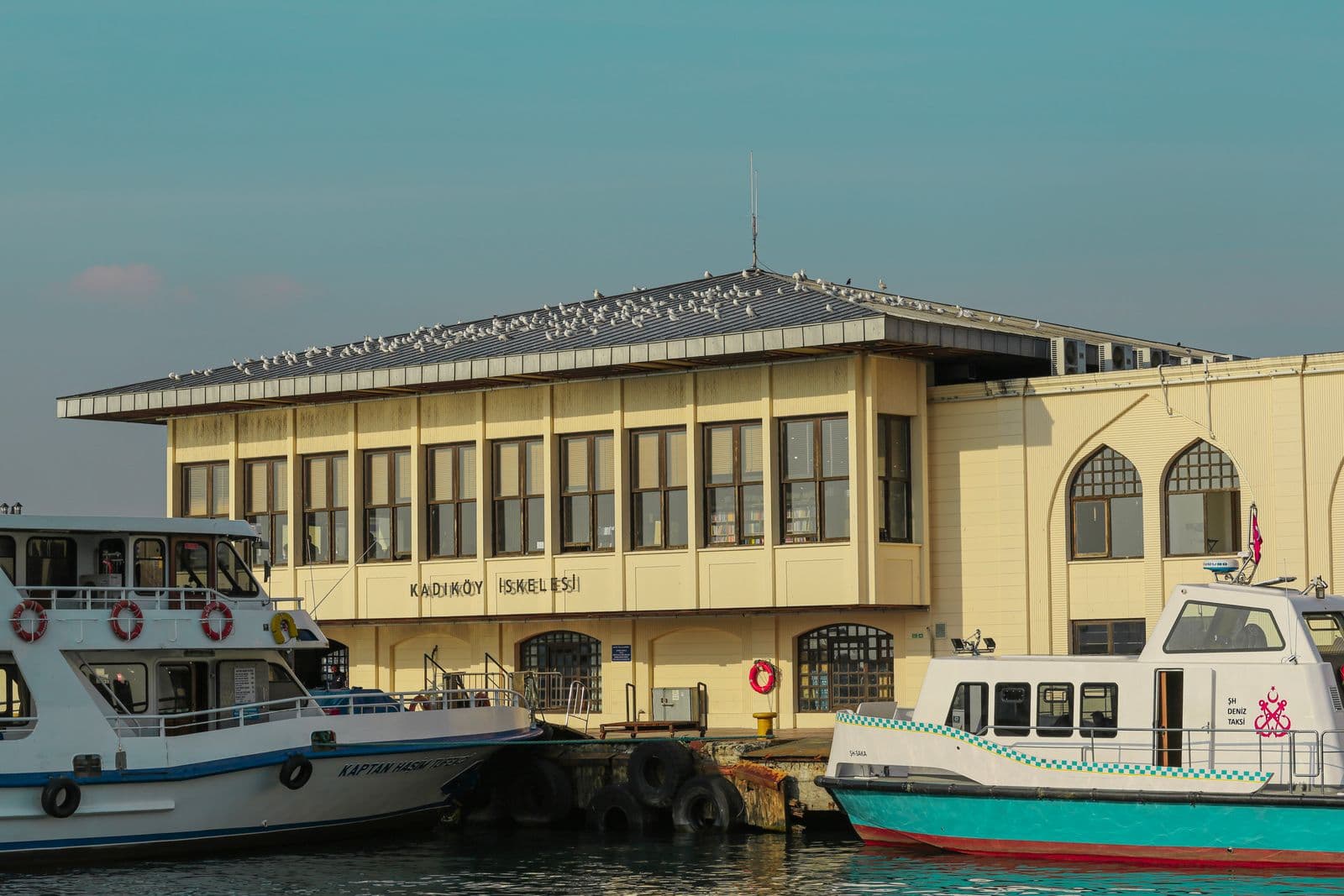
Both Kadıköy and Üsküdar are ferry towns, and the crossing is the nicest way to move on to the European shore or simply to see the city from the water. From Kadıköy İskelesi, city ferries sail to Eminönü, Karaköy, and Beşiktaş; from Üsküdar they run to Eminönü and Beşiktaş too. A ride costs a little more than a metro trip on your Istanbulkart, around ₺59 depending on the pier, and the boats run frequently through the day. The Kadıköy to Karaköy or Eminönü hop takes roughly 20 minutes and drops you steps from the European tram, a smoother handoff than any underground change.
Üsküdar adds a second rail link worth knowing: the Marmaray stops right by its ferry pier, so you can arrive by train and leave by boat, or the reverse. In 2026 the Marmaray runs late into the night seven days a week (last trains around midnight, a little later at weekends), which widens your options for a night-time hop to or from Üsküdar when the ferries have stopped. That mix of rail under the water and ferry over it is part of what makes basing yourself on the Asian side so easy to get around.
Tips and common mistakes for Asian-side arrivals
A few things catch travelers out. The M4 does not run around the clock except on weekend nights, so a late Tuesday landing at SAW may mean a bus, taxi, or transfer rather than the metro. Check the last-train time on the official Sabiha Gökçen and Metro Istanbul pages before you rely on it.
The other frequent slip is expecting a transfer discount that never arrives. On an anonymous card bought at the airport, every tap is the full fare, so a metro-plus-Marmaray hop to Üsküdar costs two fares, not a discounted one. Our Istanbulkart guide explains why, and when a contactless bank card is the smarter call.
One practical reassurance: at SAW the M4 station sits inside the terminal, a short indoor walk from arrivals, so you are not hunting for a separate shuttle to a distant platform. Buy and load your card at the machines by the entrance, keep small lira notes handy for the ones that will not take a bank card, and you can be on a train within about ten minutes of clearing customs.
Last, do not underestimate the Bosphorus. If you are flying out of IST from an Asian-side hotel, treat the crossing as its own leg and leave early; a smooth 75-minute taxi can become two hours in Friday evening traffic. Fares and timetables shift through the year, so confirm the current numbers with the operator before you travel. Compare your specific route on our SAW and IST airport pages.
Quick answers
How do I get from Sabiha Gokcen (SAW) to Kadikoy by metro?
The M4 metro runs straight from the SAW terminal to Kadıköy in about 52 minutes for ₺46.20, with no transfer needed. Trains come every few minutes at peak times.
How long does it take to reach the Asian side from Istanbul Airport (IST)?
Plan on 90 to 120 minutes and three changes by metro and Marmaray: M11, then M2 at Gayrettepe, to Yenikapı, then Marmaray under the Bosphorus to Ayrılık Çeşmesi. Each leg is charged separately on tourist cards.
Does the SAW metro to Kadikoy run at night?
The M4 trains operate 06:00 to midnight, with 24-hour service on Friday and Saturday. Outside those hours, options include the E-10 city bus (₺84, about one hour) or a private transfer.
How do I get to Uskudar from Sabiha Gokcen airport?
Stay on the M4 to Ayrılık Çeşmesi, then change to Marmaray one stop north to Üsküdar. On a tourist card expect ₺46.20 plus an additional Marmaray fare, as each leg is charged separately.
Can I take a ferry from Kadikoy or Uskudar across to the European side?
Yes. Ferries from Kadıköy reach Eminönü, Karaköy and Beşiktaş in about 20 minutes, and from Üsküdar reach Eminönü and Beşiktaş. Fares are around ₺59 depending on the pier.